Sorting through the past and creating new narratives.
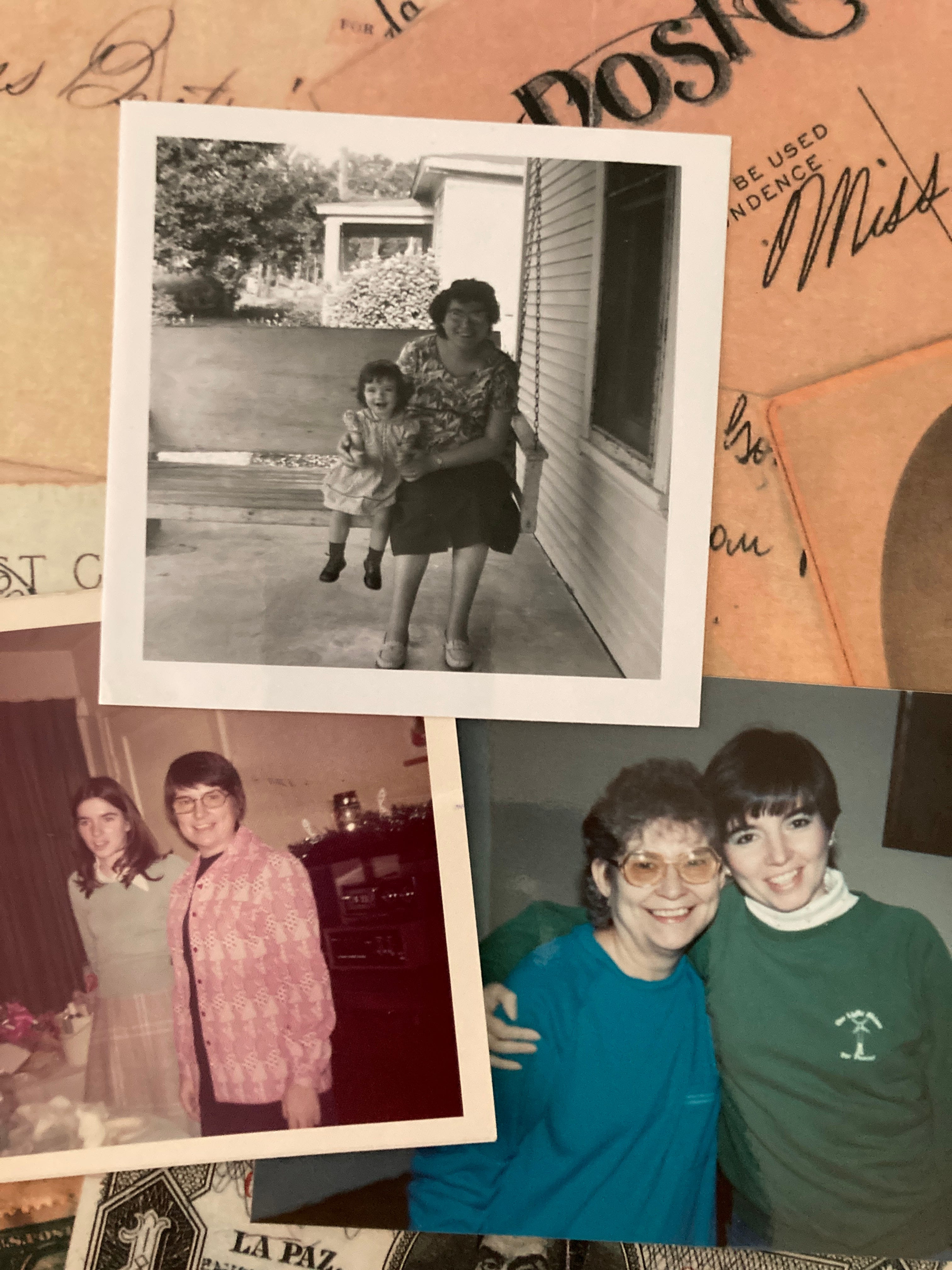
This past weekend, I opened my mom’s cedar hope chest and removed everything inside. Many times I’ve expressed the desire to move it along, but I wasn’t ready. It doesn’t really fit any rooms in my house, and it’s taking up a space where I’d like to put a chair. I’ve moved it with me to five different homes. I’ve used the hope chest as a coffee table, a TV stand, and a place to set a basket for my cat.
My parents bought a new bedroom set, which included the hope chest, when our family moved into a big new house in the 1960s. My dad was making money as an insurance agent, and things were looking up for us then, before the divorce. For almost 30 years the hope chest sat at the end of her bed. When Mom downsized and moved a couple of times, she kept the bedroom set. At the senior apartment complex where she died, I took most of her belongings to the common room to give away. Another tenant could use her bed and dresser. One of the few things I saved for myself was the hope chest and the large philodendron sitting on it (which I still have).
Why is it so hard to part with material things, especially something that represents a loved one or an emotional connection? Watch an episode of “Hoarders” and you’ll see this at its extreme. In the show, often a loved one has died and rather than part with their things, a family member simply moves it all into their own house. I can understand that; I recently wrote an essay called “Hanging On to a Memory” about the toy box my dad made when I was a little girl, which sits in my basement. My family life was unhappy and my dad a disappointment, yet the toy box reminds me of his young self, and the promise of what he could have been without bad choices and alcoholism.
My relationship with Mom was completely different. I was her best friend from birth, and when my dad left her 13 years later, I became her emotional caretaker. I can’t remember not knowing the sad story of her life…of her mother dying when she was two, separation from her four sisters, and her adoption into a poor and socially awkward family. The story of her life became my life; my purpose was to comfort her, or save her, or at the very least, try to protect her. Even now I wish I had done more, but I learned you can’t make someone else be happy.
Upon opening the lid of the hope chest, an attached shelf lifts up. My mother placed a little spiral-ringed notebook there in which she’d chronicled her life story. The first line reads, “I never knew my mother.” It’s the saddest thing I’ve ever read. But, I remember she used to say she “felt like she came out from under a rock.” She missed having a connection to her origins. Maybe this helped prove her own existence to herself. Maybe knowing the little notebook was in there kept me from opening the hope chest again for so long.
There were other treasures inside: Drawings and school projects my mom did as a child, showing an artistic flair I don’t remember; my first shoes; a baby quilt; my round blue dance case with tights and ballet slippers; children’s uniforms and badges of mine and my brothers; and, an unfinished quilt top. She couldn’t know that I’d one day become a quilter. A packet of letters from the innocent beginning of my parents’ young romance. At one time I’d added my son’s Army uniform, and an Army blanket from visiting him in Germany. These days I find it difficult to separate the good thoughts from the sad ones. Every day, every event, every item brings a complicated stream of emotions.
Our parental relationships are complicated. A man and a woman partner to provide our DNA but we are not the whole of either of them. We may see their faces reflected in the mirror, but our hearts and minds become uniquely our own. When I realized in my own adulthood how young my mom and dad were when they married and soon had me, and considered their own childhoods and upbringing, how could they have known anything about marriage or raising a child? After years of feeling disappointed, I lowered my expectations. Eventually I forgave them. Then I forgave myself for judging them. I did the same dumb thing, married at 19, had a baby at 20. We literally knew nothing. It’s a wonder any of us survive or flourish.
My mom called me “sweetie heart.” Even through hard times, we shared a sense of humor and laughed together. She taught me how to sing harmony. I love my mom, and I miss her every day. But I don’t need the hope chest to keep those special memories alive. It represents her life, not mine, and I’m ready to let it go.
I lovingly lifted each thing out of the hope chest, spent time looking and touching them, and transferred the items to a storage box for the attic. I’m giving my son’s Army uniform to my grandsons, now adult men. I’m looking forward to finishing the quilt. My husband brought a moving dolly upstairs, we turned the chest vertically on its side, and carefully eased it down the steps and out to the garage. I offered it to my niece, and if she decides it’s not for her, I’ll find it another home. The hope chest is ready to fill with new hopes and dreams.
 And Something Else